Data Analyst Agent Architecture
A production reference architecture for interruptible analysis, governed execution, evidence-backed answers, and durable evaluation.
A production data analyst agent is not a chat completion with a SQL tool. It is an interruptible system that separates user intent, governed execution, validation, evidence, and presentation while preserving one owner for the final answer.
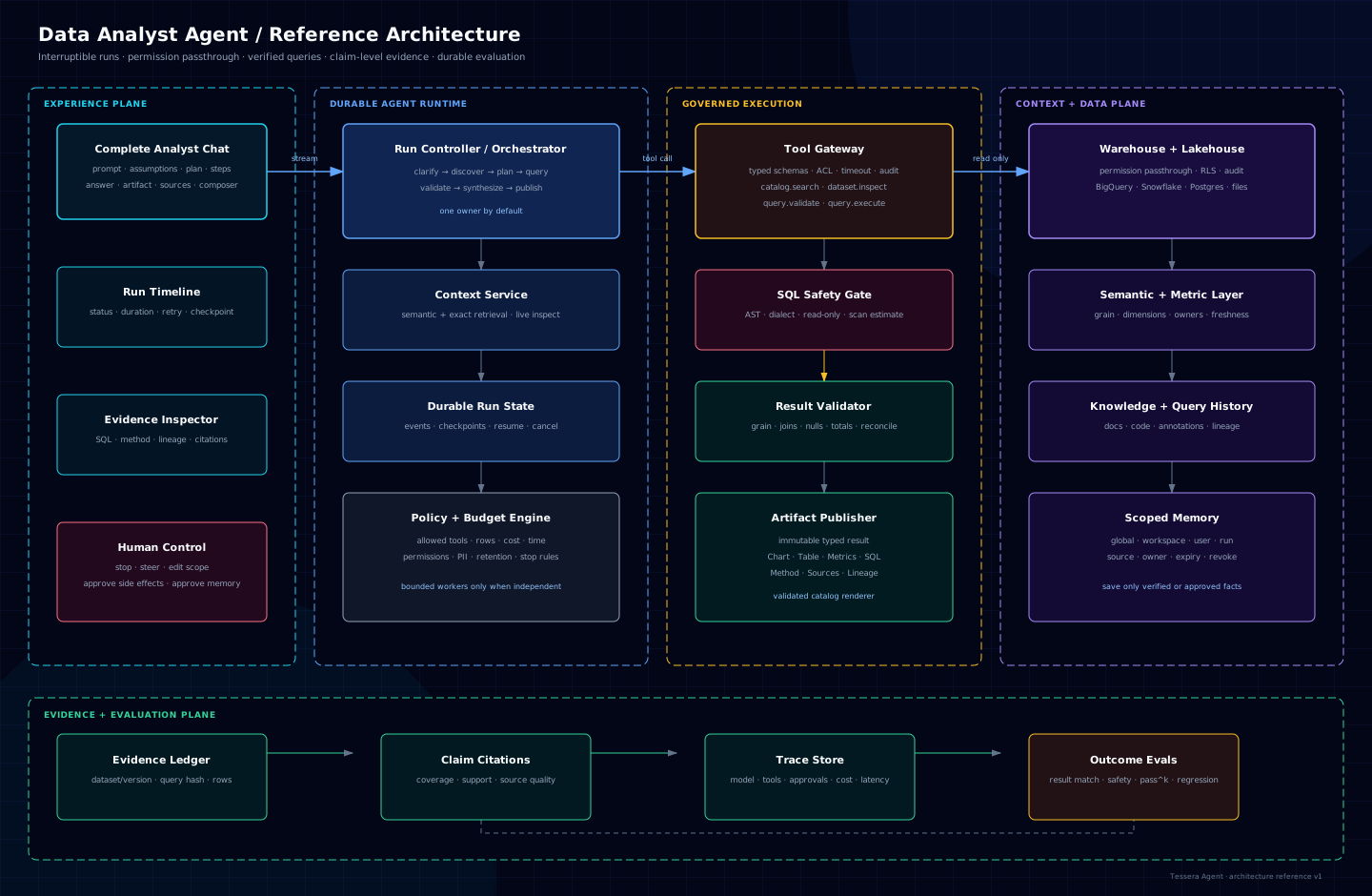
The default topology
Use one run controller as the answer owner. It clarifies the request, selects approved tools, manages budgets and checkpoints, and publishes the final response. Add bounded workers only when investigations are independent, parallelizable, and valuable enough to justify extra cost and coordination.
The architecture has four operational planes:
| Plane | Responsibility |
|---|---|
| Experience | Complete chat, assumptions, run timeline, artifacts, sources, and follow-up composer |
| Runtime | Run controller, context service, durable state, policy and budget engine |
| Execution | Tool gateway, SQL safety gate, result validator, artifact publisher |
| Context and data | Semantic definitions, warehouse metadata, scoped memory, approved data systems |
An evidence ledger and trace store span every plane. They connect claims to tool outputs and make runs reproducible without exposing private hidden reasoning.
Non-negotiable contracts
- Data access and rendering are separate tools. A render call never silently queries a database.
- Permissions pass through from the user and workspace. The model cannot grant itself access.
- SQL execution is read-only by default, scoped, bounded, and observable.
- The final answer cites claim-level evidence, not only a list of sources.
- Every artifact is versioned, declarative data validated against a strict schema. It contains no JSX, HTML, scripts, or executable formulas.
- Runs persist state before risky or long operations so they can pause, resume, retry, and accept human approval.
Why this shape
OpenAI's agent guidance treats tools, orchestration, guardrails, tracing, and evaluation as first-class parts of an agent system. Anthropic's effective agent patterns distinguish predictable workflows from autonomous agents and recommend adding complexity only when it improves results. Claude Code's documented loop similarly gathers context, takes action, and verifies work. W3C PROV supplies a durable vocabulary for entities, activities, agents, and their relationships.
Continue with the run loop, then add the safety, provenance, and evaluation boundaries before exposing production data.